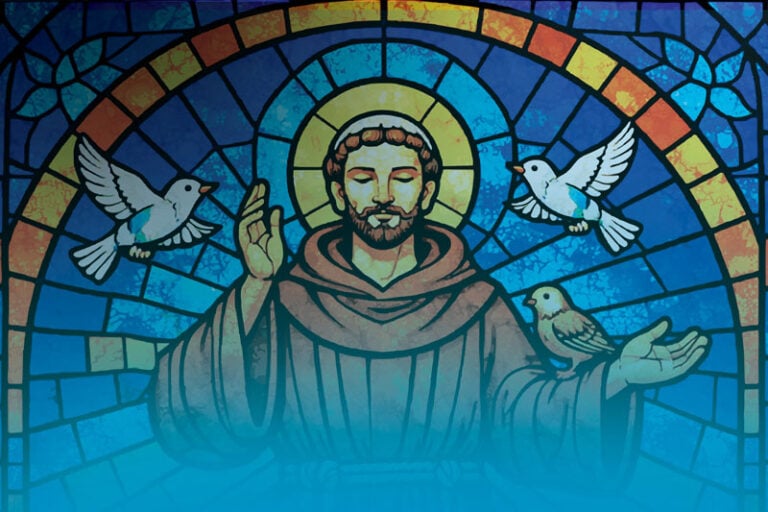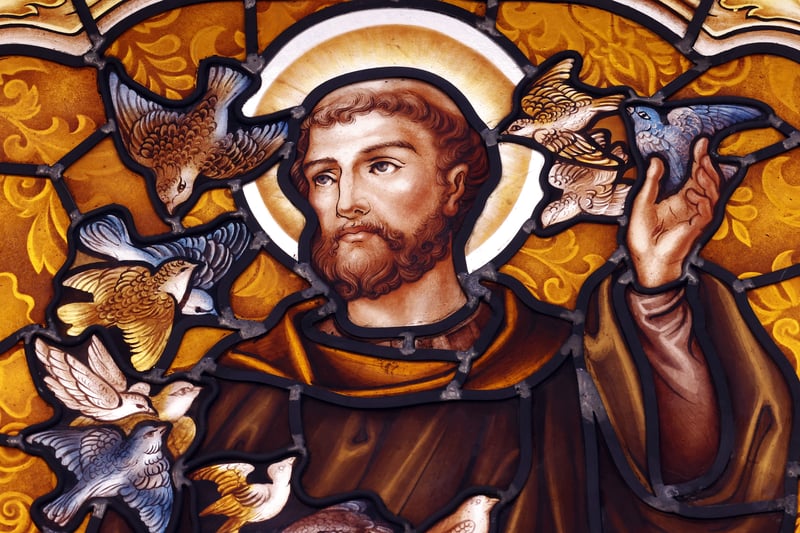
As we celebrate the Year of St. Francis, we are invited to look beyond the familiar image of the saint surrounded by birds and discover the Franciscan spirit that continues to shape the Felician Sisters today.
For many of us, the image of St. Francis of Assisi is familiar: a simple friar standing among birds and animals, a gentle smile on his face, surrounded by the beauty of creation.
It is a beautiful image—and there is truth behind it. Francis had a remarkable relationship with creation. He called the sun “Brother Sun,” the moon “Sister Moon” and saw all of creation as part of God’s family.
But there was much more to Francis.
He was a young man who dreamed of glory before becoming a friar who chose humility. He embraced poverty when the world around him prized wealth and power. He reached out to people others avoided. He listened for God’s call and continually allowed his life to be changed by it.
Francis was still becoming.
And perhaps that is the Francis we most need to remember today.
A Franciscan Spirit at the Heart of the Felician Story
The connection between St. Francis and the Felician Sisters began long before the Sisters arrived in North America.
Blessed Mary Angela Truszkowska, foundress of the Felician Sisters, was deeply influenced by Franciscan spirituality. In 1850, she joined the Secular Franciscan Order and took the name Angela. Inspired by St. Francis, St. Clare and St. Felix of Cantalice, she embraced a spirituality grounded in prayer, humility, service and love for those most in need.
When Blessed Mary Angela founded the Congregation of the Sisters of St. Felix of Cantalice in 1855, that Franciscan spirit became woven into its identity.
The Sisters were called to live simply, pray unceasingly and serve generously.
And when the first Felician Sisters came to North America in 1874, Blessed Mary
Angela gave them a simple direction: “Serve where needed.”
Those three words continue to say something important about the Franciscan spirit.
Francis did not spend his life asking where he could be most comfortable. Blessed Mary Angela did not build a congregation around comfort. Instead, both responded to what they saw in front of them: people who were suffering, forgotten or in need of hope.
They saw a need—and they responded.
The Francis We Need Today
It can be easy to picture St. Francis as the saint who preached to the birds. But perhaps the birds are only the beginning of the story. Francis’ relationship with creation came from something deeper: a profound recognition that everything is connected through the Creator. He called creation “brother” and “sister” because he understood that he was not separate from it. That same way of seeing can change how we encounter the world.
What happens when we begin to see the person in need not as a problem, but as a brother or sister?
What happens when we see someone who is lonely and choose to reach out? When we encounter someone whose life is different from our own and choose curiosity instead of judgment? When we look at the earth not simply as a resource, but as a gift entrusted to us? When we recognize that caring for creation and caring for our neighbor are not separate acts, but expressions of the same love? This is the Franciscan challenge. It asks us not simply to admire Francis, but to see as Francis saw.
Four Ways of Living the Franciscan Spirit
For Felician Sisters, Franciscan spirituality is not simply something we study. It is a way of life. Four Franciscan values provide a foundation for that life:
- Minority calls us to humility—to resist the desire for power or prestige and to place ourselves alongside others rather than above them.
- Prayer calls us to remain attentive to God—to create space to listen, discern and recognize God’s presence in our lives and in the world around us.
- Poverty calls us to simplicity and trust—to recognize that we are stewards rather than owners and that what we have is ultimately a gift.
- Conversion calls us to remain open to change—to continually turn toward God and allow our lives to be transformed.
These values are not confined to the past. They challenge us today.
Still Becoming
Perhaps one of the most beautiful things about Francis’ story is that he did not begin as the saint we recognize today. He was a young man with ambitions, dreams and a desire for recognition. His life changed gradually as he encountered God in unexpected places and among unexpected people.
Blessed Mary Angela, too, responded to God’s call one step at a time.
Neither knew exactly where that call would lead.
That may be an important message for us during this Year of St. Francis.
We do not have to have everything figured out.
We simply have to remain open.
Open to the person who needs us.
Open to a new way of seeing.
Open to changing direction.
Open to discovering God in places we might not expect.
Open to the needs of creation and our neighbors.
Open, as Francis and Mary Angela were, to becoming the people God calls us to be.
Eight hundred years after Francis wrote the Canticle of the Creatures, his song still invites us to see the world differently. Brother Sun. Sister Moon. Brother and Sister. A world filled with God’s presence.
And perhaps that is the Francis we most need today—not simply the saint with the halo, or even the saint surrounded by birds, but the young man who was still becoming, the friar who learned to see every person and every part of creation as a gift, and the follower of Christ who responded to love by serving wherever he was needed.
That is a Franciscan spirit.
And it is a spirit that continues to live in the Felician Sisters.