Sister MaryAnne Olekszyk continues to minister to the women at St. Felix House and at the newly opened Hope House, which was built on the site of the former nursery and St. Felix Centre building. Since Hope House’s official opening in June, the following two months have seen a gradual move-in of women and children, with all 31 apartments filled by September. Among the residents are seven children and one expectant mother.
In the months leading up to the opening, donations of kitchen, bathroom and bedroom items, as well as toys, were collected at Holy Name of Mary Convent in Mississauga, ON. On September 24, Sister MaryAnne delivered a carload of these items to Hope House.
Residents were invited to select what they needed. Sister MaryAnne was delighted to meet some of the women, and one encounter especially touched her. A young woman initially chose two houseplants but decided to take only one. When Sister MaryAnne asked if she had changed her mind, she replied, “Maybe someone else wants one. I’ll come back at the end of the day, and if it’s still there, I’ll take it.” That small gesture of thoughtfulness gives hope for a culture of generosity and loving community at Hope House.
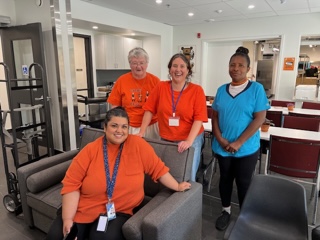
That same spirit of community was evident again on September 30, the day Canada commemorates the anniversary of the “Truth and Reconciliation Commission Report.” The St. Felix Centre management team hosted a gathering for each of the four housing groups—Hope House, St. Felix House, Adelaide St. Respite Centre, and 69 Fraser Respite Centre. The meal featured Bison Shepherd’s Pie from an Indigenous kitchen. At Hope House, several participants learned the art of beading, taught by one of the residents, while Indigenous music played in the background.
Participants wore orange shirts in remembrance of Phyllis Webstad, a Northern Secwépemc (Shuswap) girl who, in 1973, arrived at the St. Joseph Mission Residential School wearing a brand-new orange shirt given to her by her grandmother. The shirt was taken from her on her first day and never returned—a painful symbol of how Indigenous children were stripped of their identities, families and culture in the residential school system. The children’s long hair was cut and their clothing replaced with uniforms. Many who died in the schools were never returned to their families. Today, Orange Shirt Day and the words “Every Child Matters” serve as powerful reminders of this history and the ongoing call for truth, reconciliation and justice.